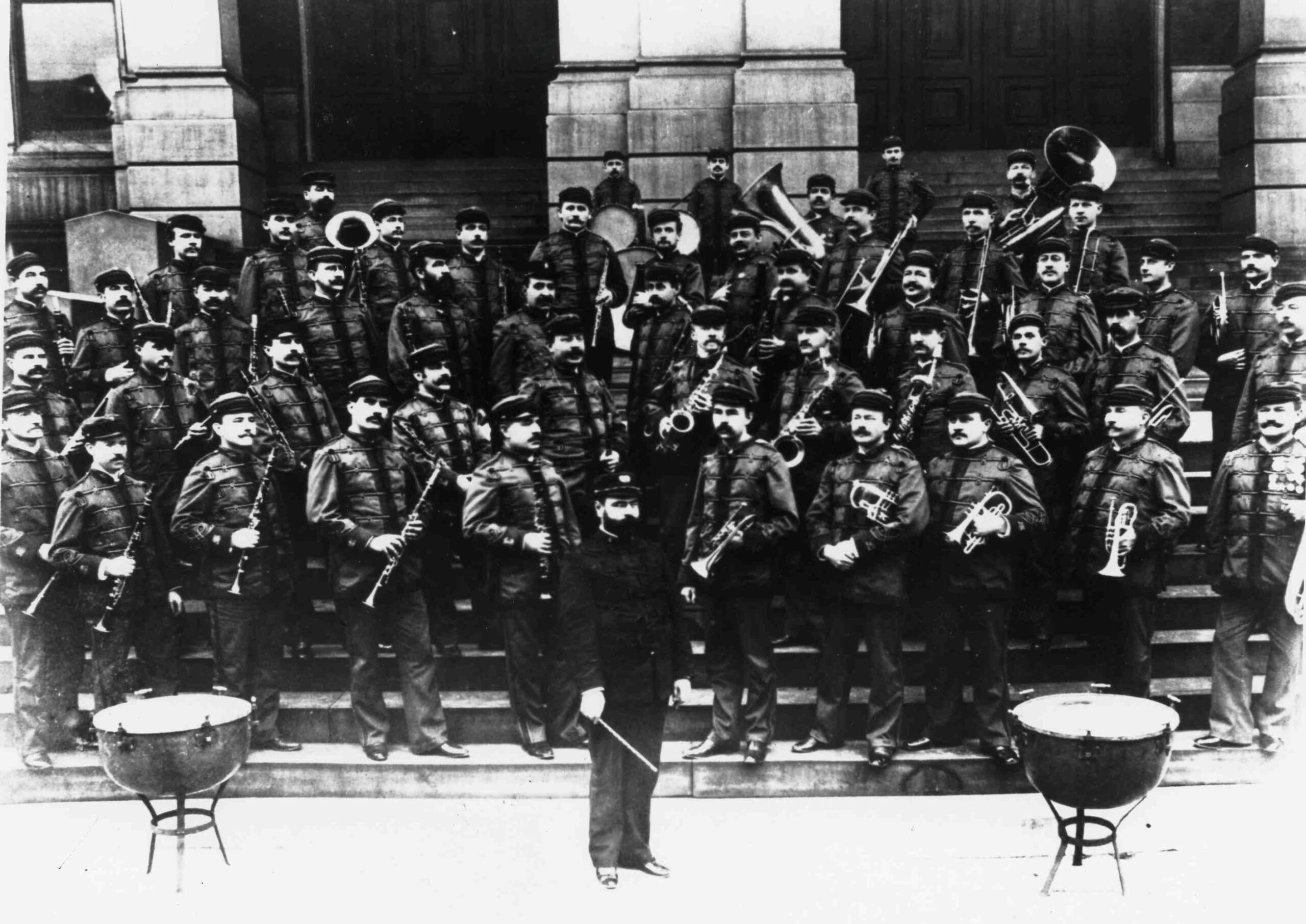
An 1893 image of John Philip Sousa’s civilian band, formed after his departure from the Marine Corps. Notice the band’s Marine Corps-inspired uniforms. United States Marine Band Library and Archives
An integral part of Washington, DC’s summer soundscape are the strains of the United States Marine Band wafting from the Capitol steps along the National Mall. For many, the repertoire of the Marine Band is the sound of America. For years, the Marine Band has described itself as “performing America’s music since 1798.” That music tends to be a grand potpourri of Sousa marches, popular songs, and music from the classical canon. This mix of music, the music one dreams up of when one imagines “patriotic music,” is curious. Take, for example, the use of Piotr Ilitch Tchaikovsky’s 1812 Overture as the grand finale for an American Independence Day concert. How does the music written by a nineteenth century Russian, celebrating a Russian military victory over the French become the de facto soundtrack of the Fourth of July? In many ways, this uniquely American transmutation of musical context can be traced back to the Marine Band. Francis Scala and John Philip Sousa, two important leaders of the United States Marine Band who are both interred at the Congressional Cemetery, cemented this musical mélange as the American soundtrack paving the way for the Marine Band of today and other ensembles across our country.
Scala was born around 1820 and trained in his native home of Naples, a center of music for centuries in pre-unification Italy. Scala’s childhood and young adulthood was marked by a time of cultural collision: the incursion of French influence in a region with deep musical traditions and vitality. The depth of Neapolitan musicianship was no accident, as formal music education took place in Naples as early as the sixteenth century. In fact, the modern usage of “conservatory” as a place of musical training began in Naples. The Conservatorio della Pietà dei Turchini and the Conservatorio dei Poveri di Gesù Cristo were known for its training of young musicians by prominent music teachers by the sixteenth century. When these institutions were founded, however, musical training was not the goal of the Conservatori. They were places to “conserve” orphans. Music was a necessary and important part of their education. Eventually the term conservatorio became broadly used as a place of musical education.
One of the lasting changes in the landscape of Neapolitan culture brought by Napoleonic rule in the early nineteenth century was the unification of Naples’s conservatories into a single institution known as the Real Collegio di Musica. This is the institution where the young Scala was trained at. At the Real Collegio, Scala would have been immersed Naples’s musical life: a life that was centered around operatic innovation. Naples was home to Gioachino Rossini, the prolific opera composer known for his masterworks like Il barbiere di Siviglia (The Barber of Seville) and La gazza ladra (The Thieving Magpie), from 1815 to 1822. Gaetano Donizetti, one of the proponents of the bel canto movement through his operas like Lucia di Lammermoor and L’elisir d’amore (The Elixir of Love), was the director of the Neapolitan royal opera houses from 1827 to 1838.
However, the concert and operatic music of Naples only represents one side of Neapolitan musical fabric. Outside of the opera hall, Naples was filled with popular and folk songs written and sung in the local dialect. Although the most familiar Neapolitan songs like “’O sole mio” and “Funiculì funiculà” were not written until after Scala’s immigration to the United States, one imagines this mix of art and popular music simmering in Scala’s mind.
Scala initially enlisted as a third-class musician on the USS Brandywine in 1841, teeing up his later service in the Marine Corps. Things, however, went south for Scala soon after the Brandywine left to cross the Atlantic. He was terribly susceptible to seasickness. He remembered that:
Finally we reached Norfolk. I was determined that I should never again go near salt water and I soon secured my discharge not having been a year in the Navy. Then I was asked to become a bandmaster in the Army, stationed at Fortress Monroe. I was about to accept it, but then I looked at all the salt water around the fort and declined the position.
Instead, Scala enlisted in the Marine Band on August 11, 1842. At the time, the Marine Band was an extremely different organization than the world-class music ensemble it is today. In Scala’s words:
It wasn’t much of an organization then. Congress had made no provision for the band, so that the ten or twelve members were enlisted as fifers and drummers, there being two leaders, a fife major and a drum major.
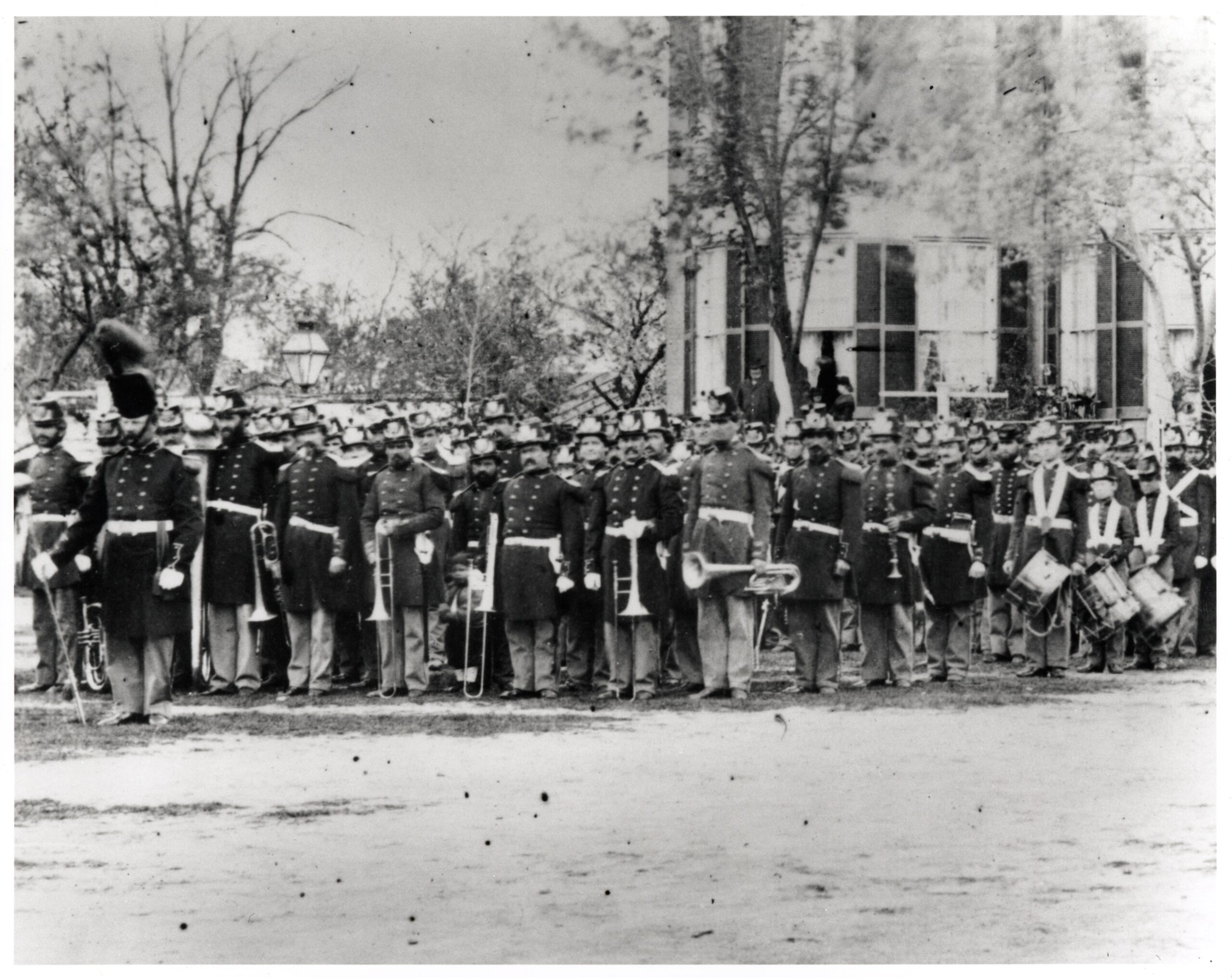
Earliest known photo of the Marine Band in detail. This is an inset of a full battalion photo taken on the Parade Deck of Marine Barracks Washington in 1864. United States Marine Band Library and Archives
Scala quickly rose through the ranks of the Marine Band. He became fife major in 1843, and was eventually placed in charge of the whole band in 1855. In this time, the band grew significantly. An arrangement of Black American songs arranged for the Marine Band’s performance by Scala’s predecessor in leadership, Rafael Triay, includes parts for three piccolos, sopranino clarinet in E-flat, five B-flat clarinet parts, bugle, trumpet, five parts for various kind of cornet, two tenor trombone parts, bass trombone, ophicleide, tuba, and bass drum for a total of twenty-two separate parts. Of note is the near parity of parts for woodwind and brass instruments. Triay, who was a European immigrant like Scala, hailed from Spain and had a similar, cosmopolitan idea of repertoire for the Marine Band. However, this instrumentation was unusual for American bands of the mid-nineteenth century. Although woodwind-led, European-styled military bands did exist in the United States at the time, they were not nearly as common as the brass bands that dominated American wind band culture. This marriage of both woodwind and brass timbres became characteristic of the United States Marine Band and persists to the present day.
Like Triay before him, Scala’s musical upbringing is reflected in his collection of music for the Marine Band. Music by contemporary Americans is represented, like the marches and quicksteps of Claudio Grafulla. However, the art music of Scala’s homeland has great representation. The music of Vincenzo Bellini and Donizetti, the great bel canto opera composers and residents of Naples for periods of their careers, make up a disproportionally large amount of Scala’s library. Significantly, multiple arrangements of music written by Jacques Offenbach, the French operetta composer, are in Scala’s library. Scala’s arrangement of music from Offenbach’s Geneviève de Brabant, includes the melody of gendarmes duet from the 1861 version of the operetta. This duet, “Protége le repos des villes” (“To protect the peace of the towns”), has uncanny resemblance to the modern-day Marines’ Hymn, making Scala one of the first musicians to introduce the Marine Corps to the melody of its beloved hymn.
One can imagine a Marine Band program of the time effortlessly blending a mix of American patriotic favorites, selections from the European opera house, and novelty and popular music of the day. Many of the Marine Band’s concerts during this era were held on the White House lawn. The Marine Band’s weekly concerts at the White House were panacea for the music-loving Abraham Lincoln. Lincoln was known to listen to the Marine Band with the curtains closed. Francis B. Carpenter, a painter most known for his painting First Reading of the Emancipation Proclamation of President Lincoln, lived at the White House with Lincoln for a period of time. In his memoir, Six Months at the White House with Abraham Lincoln, Carpenter describes the frustration Lincoln felt trying to listen to the Marine Band. President Lincoln stepped onto the White House portico and:
Instantly there was a clapping of hands and clamor for a speech. Bowing his thanks, and excusing himself he stepped back into the retirement of the circular parlor, remarking with a disappointed air, as he reclined upon the sofa, ‘I wish they would just let me sit out there quietly, and enjoy the music.’
The favor Scala curried with President Lincoln led to the most important piece of legislation involving the Marine Band. On July 25, 1861, Lincoln approved an act of Congress that formally established the United States Marine Band, beyond the “thirty-two fifers and drummers” of 1798. This Act of Congress established the band as one principal musician, designated the “Leader” of the Marine Band, thirty musicians, and retained the Drum Major as authorized in 1798. This cemented the Marine Band’s place in the civic life of Washington, DC, and gave the Marine Band a base to flourish.
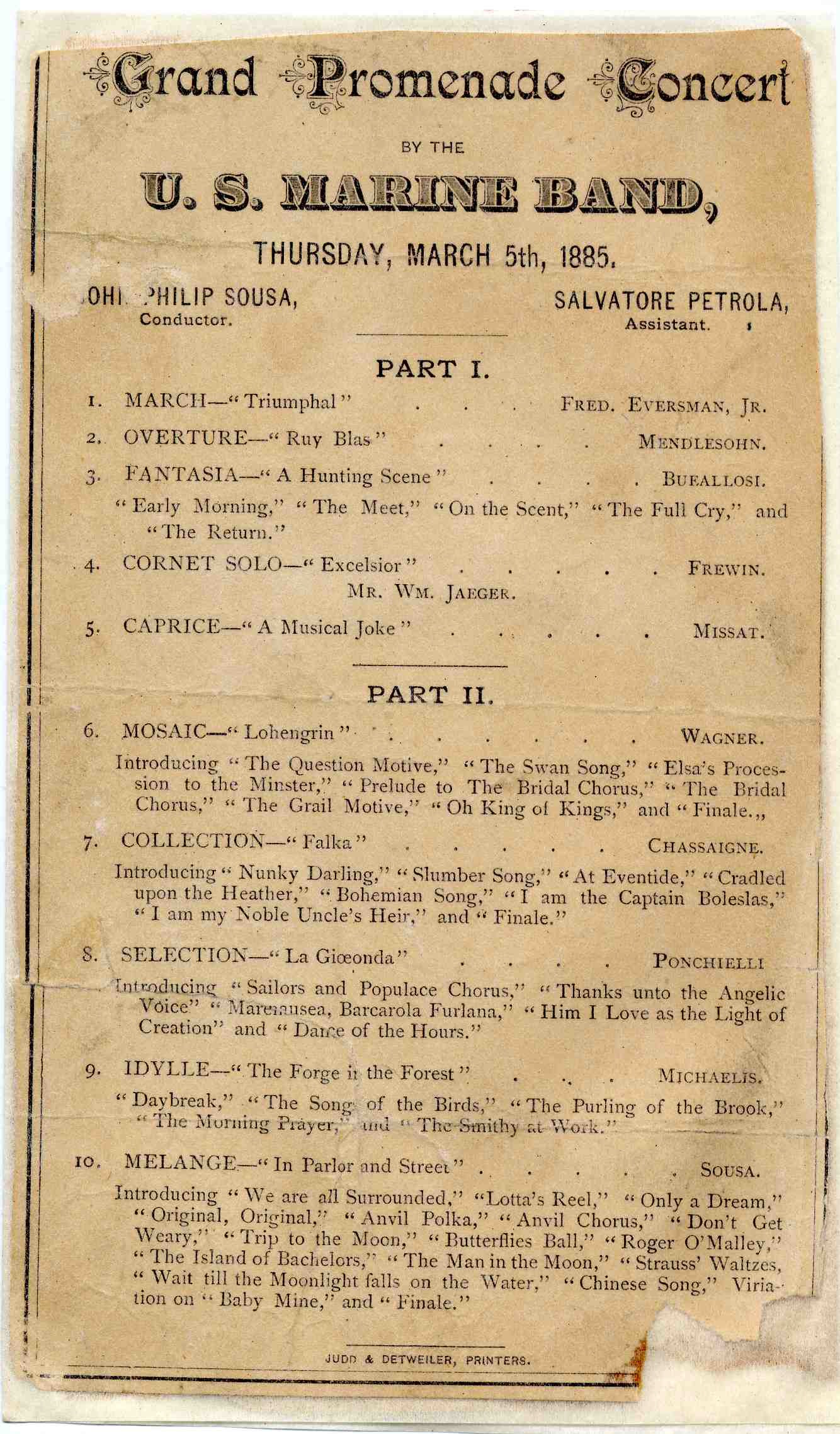
A concert as programmed by John Philip Sousa in 1885, featuring a characteristic mix of classical, popular, and works by Sousa. United States Marine Band Library and Archives
John Philip Sousa would have known Scala’s Marine Band well. Sousa was born on November 6, 1854, in Washington, DC, to two immigrants: João António de Sousa of Spanish birth to Portuguese parents and Maria Elisabeth Trinkaus of Bavarian birth. João António, known as simply Antonio here in the United States, was a musician and played trombone in the Marine Band under Scala. John Philip, the third of ten children, followed in his father’s musical footsteps. As he later remarked in his biography Marching Along, “Washington was, in those Civil War days, an armed camp, and there were bands galore. Strange is the boy who doesn’t love a band!”
Young John Philip enlisted in the Marine Corps at age thirteen as a boy apprentice musician. Later in life, John Philip described his enlistment as a surprise. He tells that he was recruited by a circus bandleader to join a circus band as a talented young violinist. John Philip was to leave Washington secretly the next morning but was intercepted by his father Antonio who marched him to his enlistment with the Marine Band. Although a particularly effective origin story for the “March King,” musicologist Patrick Warfield has found the story difficult to verify. Warfield’s research reveals no evidence that any circus was touring Washington on June 8, 1868. The story, though, reveals Sousa’s knack for theatricality with his public persona. This trait would serve him well upon his return to the Marine Band as its director in 1880.
Sousa’s musical world was vast. The variety of music performed by the Marine Band in the nineteenth century, the growing influence and popularity of light opera and operetta in the United States, and the growing repertoire of American popular music had a profound effect on his musical sensibilities. He learned from the Marine Band that musical variety was of primary importance. In total, Sousa wrote 130 marches. However, he composed in varied genres and forms, ranging from art song, programmatic and descriptive suites, operetta, and novelty works. During his tenure as Leader of the Marine Band, Sousa looked to realize the work begun by Scala, transforming the band into an emblematic symbol of American musical talent and innovation.
According to contemporary reports, Sousa inherited a band that was not prepared for the national stage. Commandant Charles G. McCawley of the Marine Corps described the Marine Band at the time as needing a “complete reorganization” and that “The band gives me more trouble the all the rest of the corps put together.” Sousa imposed new performance standards on the band’s members. This caused pushback, and the band shrunk to a mere thirty-three members by the end of Sousa’s first year as Leader. Sousa’s clout in the civilian performance world helped him recruit new, far more accomplished musicians to the Marine Band’s ranks.
Eventually, the Marine Band rose to the international prominence Sousa dreamed of. The acme of Sousa’s career with the Marine Band was the band’s two national tours in 1891 and 1892. With these tours, the Marine Band became a national symbol of musical excellence. On the band’s first tour, a Chicago critic wrote “the playing of the band, so far as accuracy of note and purity of tone are concerned, is so nearly faultless, that it is virtually the perfection of band music.” This was high praise in comparison to Commandant McCawley’s frustrations with the band in 1880.
Sousa’s programming on these tours was eclectic, to say the least. The programs opened with a classical overture. On the 1891 tour, the selections were Felix Mendelssohn’s Son and Stranger and Richard Wagner’s overture to Rienzi. The programs closed with an American patriotic song. In 1891 it was one of the de facto anthems of the United States, either “Hail! Columbia” or “The Star-Spangled Banner.” Much of the programs consisted of orchestral transcriptions of works as varied as Franz Schubert’s Unfinished Symphony, Berlioz’s The Damnation of Faust, and Rossini’s William Tell. Sousa’s works peppered the rest of the programs. Encores featured Sousa’s shorter, character pieces like his marches. Sousa’s longer works like The Chariot Race filled out the programs, as well as works to feature soloists from the band. On that 1891 tour, a guest soprano soloist joined the Marine Band.
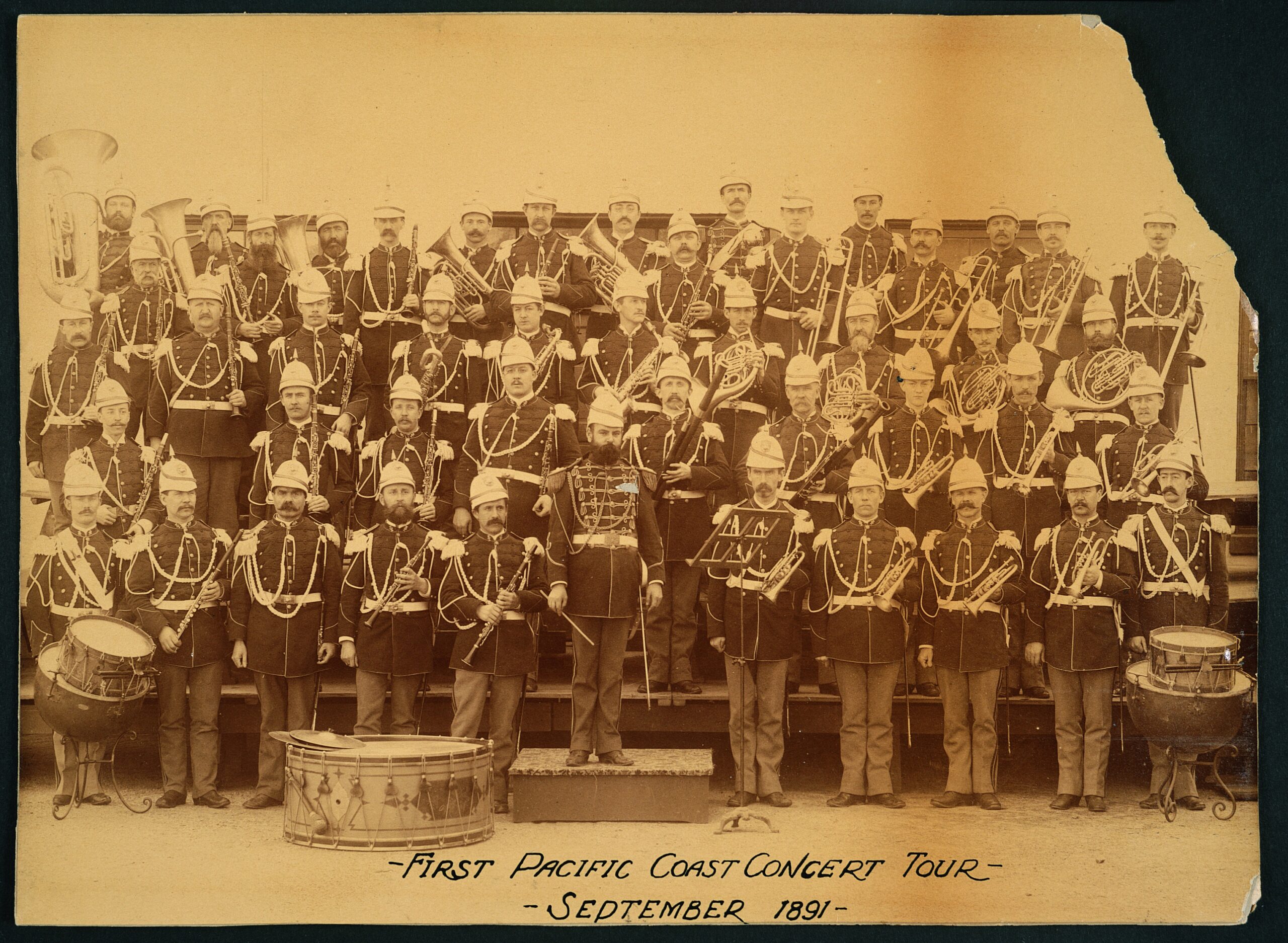
The Marine Band, as led by John Philip Sousa, on its first national tour in 1891. United States Marine Band Library and Archives
A listener immediately understands the appeal of a Sousa program and Sousa knew he hit upon a winning formula. He wrote, “I try to cater to all tastes. Every one of my programmes will have one or two pieces of a high character, then three of four of a lighter character, and the rest is of the intensely popular order.” This was in stark contrast to other trends in American musical programming of the era. There was no greater display of these two competing ideas of programming than the 1893 performances of the Chicago Symphony Orchestra and Sousa’s “New Marine Band,” the newly-created professional civilian band Sousa led after his departure from the Marine Band, at the World’s Fair. Theodore Thomas, the first music director of the Chicago Symphony Orchestra, felt the American public needed education. He dedicated the Chicago Symphony Orchestra’s concerts to “illustrat[e]…music in its highest forms as exemplified by the most enlightened nations of the world,” were sparsely attended. However, Sousa’s concerts were attended by the thousands. Thomas begrudgingly decided that at the Columbian Exposition, “Music shall not figure as an Art at all but be treated merely on the basis of an amusement.”
Over the course of the twentieth century, the Marine Band sought to bridge this gap of art and amusement. In 2026, the Marine Band boasts an impressive ability to perform an incredible variety of music. All the musicians of the Marine Band audition and win their positions in the unit on the basis of a screened audition of primarily Western art music. The versatility of the Marine Band’s musicians, however, allows the ensemble to perform in a myriad of configurations: as a big band, as a Latin jazz ensemble, as rock band, and as world music ensembles. Incredibly, in a 2023 state dinner in honor of Prime Minister Narendra Modi of India, the Marine Band received praise from the Hindu-language press for its performance of Indian classical music.
As the Marine Band continued to grow in the twentieth and twenty-first centuries, this commitment to presenting, commissioning, and recording a wide breadth of musical styles. As a significant example, the Marine Band commissioned composer David Rakowski in 2000. The result of this commission, Rakowski’s Ten of a Kind, a concerto for ten solo clarinetists and wind ensemble, was a finalist for the 2002 Pulitzer Prize in music.
The Marine Band’s concerts still reflect the influence of Sousa and Scala’s programming styles: a blending of old and new music, art and popular music, and the profound intersections of the two. Take, for example, the blend of music presented at the Marine Band’s 2023 change of command ceremony, a concert that made a profound statement about the musical legacies and musical interests of outgoing Marine Band Director, Colonel Jason Fettig and the Marine Band’s current Director, Lieutenant Colonel Ryan Nowlin. Only at a Marine Band concert can one effortlessly blend marches by Sousa, songs of Irving Berlin, concert band masterworks like Percy Grainger’s Lincolnshire Posy, orchestral transcriptions, and world première works for band. Notice that this blend of music, is not unlike the repertoire presented at the “Americana” themed Fourth of July concerts like the National Symphony Orchestra’s Capitol Fourth concert or the Boston Pops’s Fireworks Spectacular. The legacy left by the Marine Band’s historic directors is one that has defined the American soundscape for generations. It is a proud legacy that the Marine Band will continue to cultivate in the years to come.
Works Cited
Di Benedetto, Renato and Dinko Fabris. “Naples.” In The New Grove Dictionary of Music and Musicians, 2nd Edition, edited by Stanley Sadie. Grove, 2001.
Ingalls, David M. “Francis Scala: Leader of the Marine Band, 1855-1871.” DMA diss. Catholic University of America, 1957.
Kirk, Elise K. “Music in Lincoln’s White House.” White House Historical Association. Accessed July 27, 2026. https://www.whitehousehistory.org/music-in-lincolns-white-house.
Morning [Washington, DC] Times. “Scala’s Musical Past.” January 19, 1896.
The Pulitzer Prizes. “2022 Prize Winners and Finalists.” Accessed July 28. 2026. https://www.pulitzer.org/prize-winners-by-year/2002.
Sousa, John Philip. Marching Along: Recollections of Men, Women, and Music. Boston: Hale, Cushman, and Flint, 1928. Retrieved from https://archive.org/details/marchingalongrec0000john/page/n7/mode/2up.
Warfield, Patrick. Making the March King: John Philip Sousa’s Washington Year, 1854-1893. Champaign, IL: University of Illinois Press, 2013.
 Roots/You Belong Here
written by
Philip Espe
Librarian and the Historian of "The President's Own" United States Marine Band
President's Pick
May 17, 2022
stay up to date
When you sign up for our mailing list, you’ll receive closure notifications, event information, and general updates.