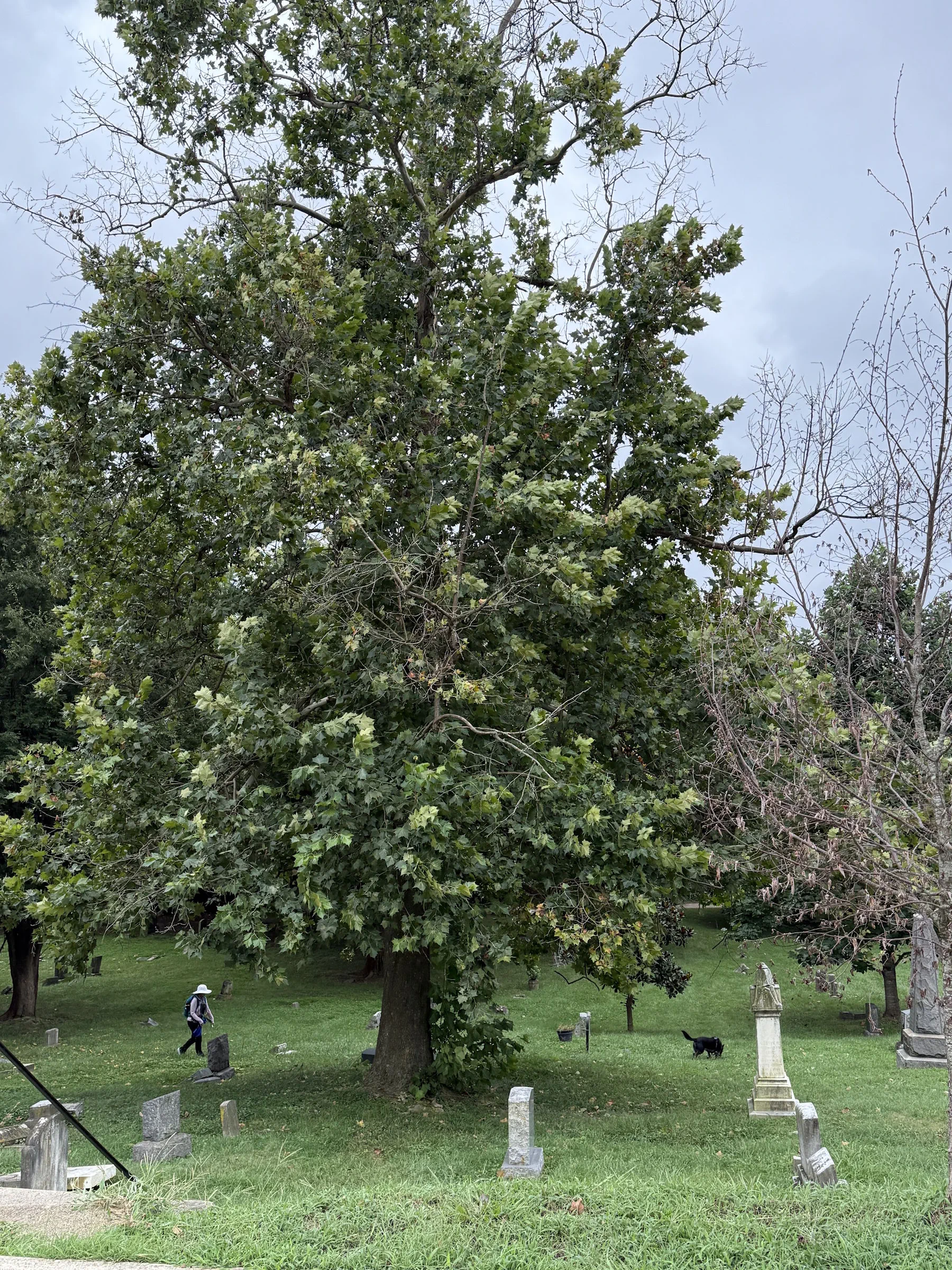
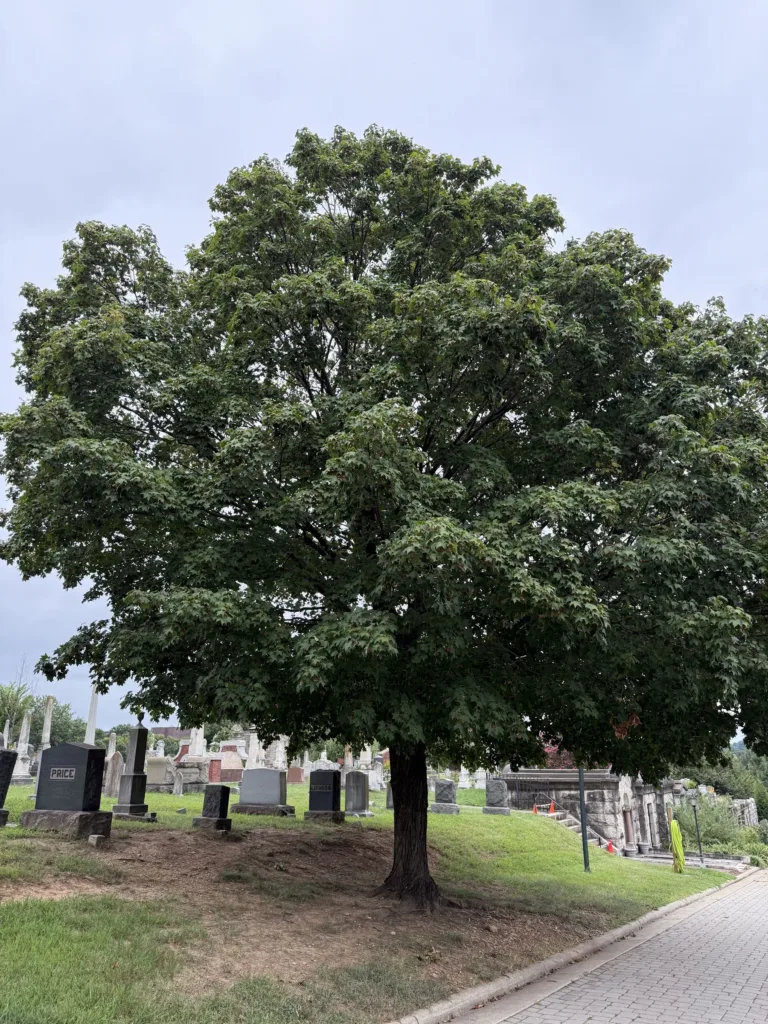
The American sycamore is a massive, long-lived, deciduous tree. While it reaches the same heights some other large trees do, it dominates in trunk girth and canopy. It can spread out more than 44 ft., with trunks that can be nearly 13 ft. in diameter. Due to its size and fast growth rate, the American sycamore’s bark is sectioned into large, fragile pieces that fall off as the tree becomes larger. The trunk is mottled in quality, often being green and gray with the older and newer bark pieces.
Outside of its size, distinguishing features of the American sycamore include: its pale green, three- to five-lobed leaves, which often have color striation when they color in the fall; its fruit, which hangs in tightly bundled dry fruits in a sort of solitary spiked ball; and its early autumn leaf-buds, which are sticky and protected by a hard casing made up of modified leaf-stem.
The oldest and largest specimens are thought to be 600+ years old, while the typical American sycamore can live to around 200. These old trees serve an important function in their home ecosystem, hollowing out as they die and becoming habitat for a variety of creatures, including those as small as a squirrel and as large as a black bear. There is even a record of a father and son living in the hollow trunk of a sycamore for almost a year in the 1740s.
The American sycamore’s size has also traditionally aided the indigenous people where it grows. It is a favorite for making large dugout canoes (literally carved from a single piece of wood– the center “dug out”) and for making large berry gathering bowls.
ALSO KNOWN AS: American Planetree, Western Plane, Occidental Plane, Buttonwood, and Water Beech
FAMILY: Platanaceae
NATIVE STATUS: Native
NATIVE RANGE: Southeastern United States
FOLIAGE: Deciduous
MAX. HEIGHT: 174 ft.
MAX. AGE: 600 yrs.
Stop #16 on the Congressional Tree Walk