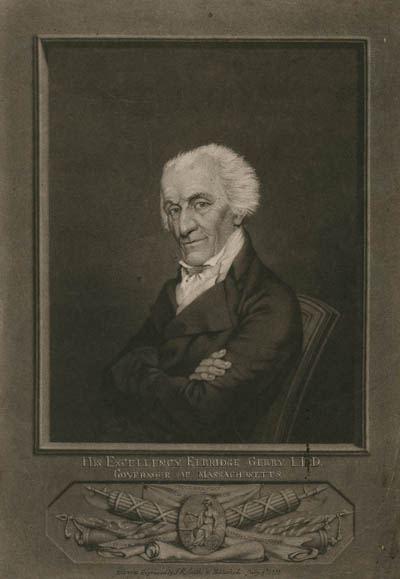
His Excellency Elbridge Gerry LL.D. governor of Massachusetts. Mezzotint by John Rubens Smith, based on a painting by John Vanderlyn. Boston: Engraved by J.R. Smith & published, July 4, 1811. Massachusetts Historical Society.
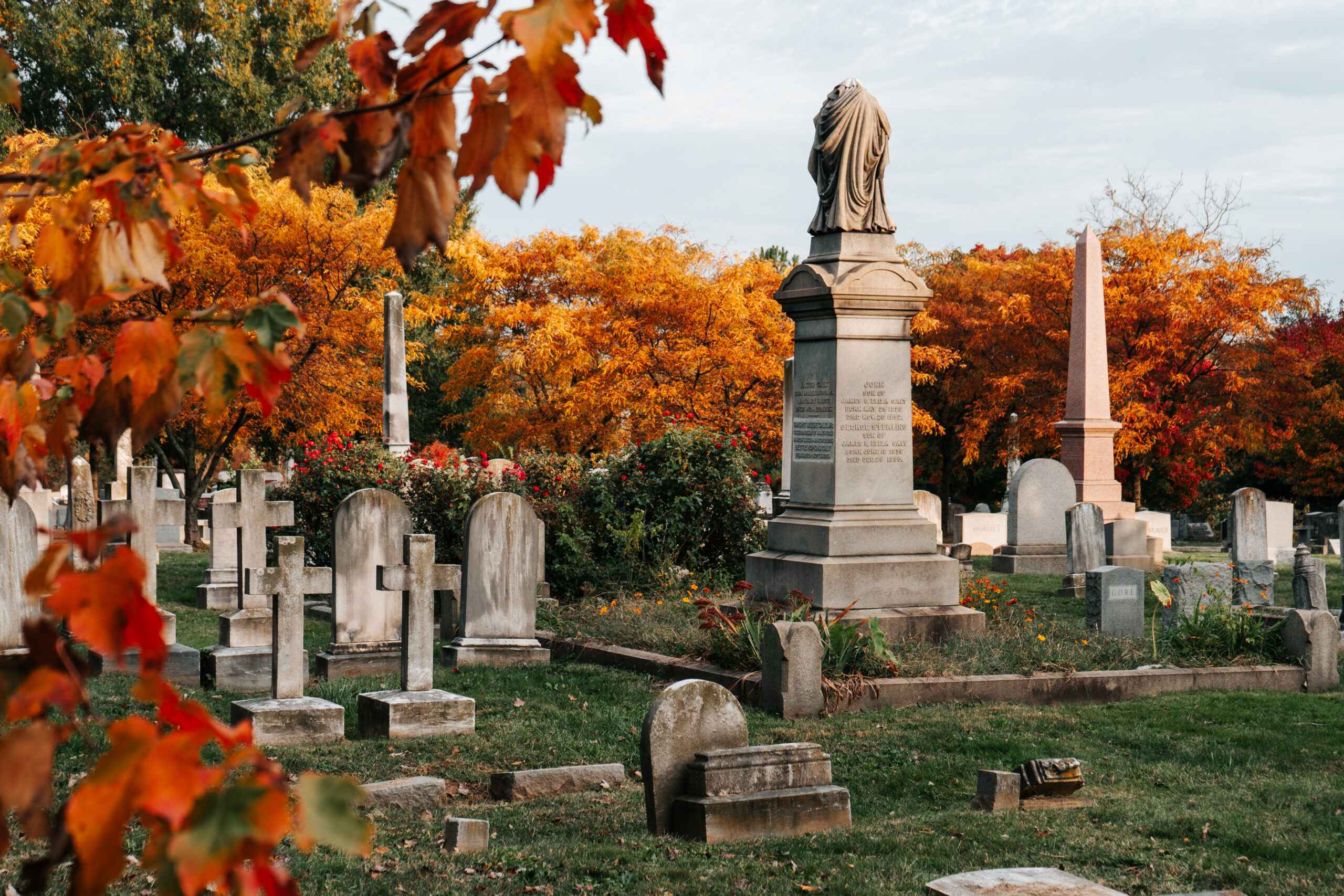
Near the perimeter of Historic Congressional Cemetery, on E Street, a 12-foot monument topped with what its designers described as a “towering and animated flame” in a Grecian vase is a sentinel in the grounds’ oldest section. Funded by Congress, the memorial was carved from Massachusetts marble by brothers William and John Frazee and erected in 1823. Writer Egon Verheyen notes, “Size and elegance—as well as material—distinguish this tomb from the modest yet impressive cenotaphs” designed by Benjamin Latrobe that stretch south in three rows. “The great number of these cenotaphs stresses the idea of equality in death,” he says, adding that the “simplicity of Latrobe’s design makes that of the Frazees appear even more lavish than it is.”
But whose résumé merited a monument that dwarfs that of congressmen? A man who signed the Declaration of Independence; who served as the magistrate of his commonwealth; who was nationally elected and was just one heartbeat away from the presidency; whose most memorable legacy is a controversial political stratagem that bears his name, albeit mispronounced. This is the final resting place of Elbridge Gerry.
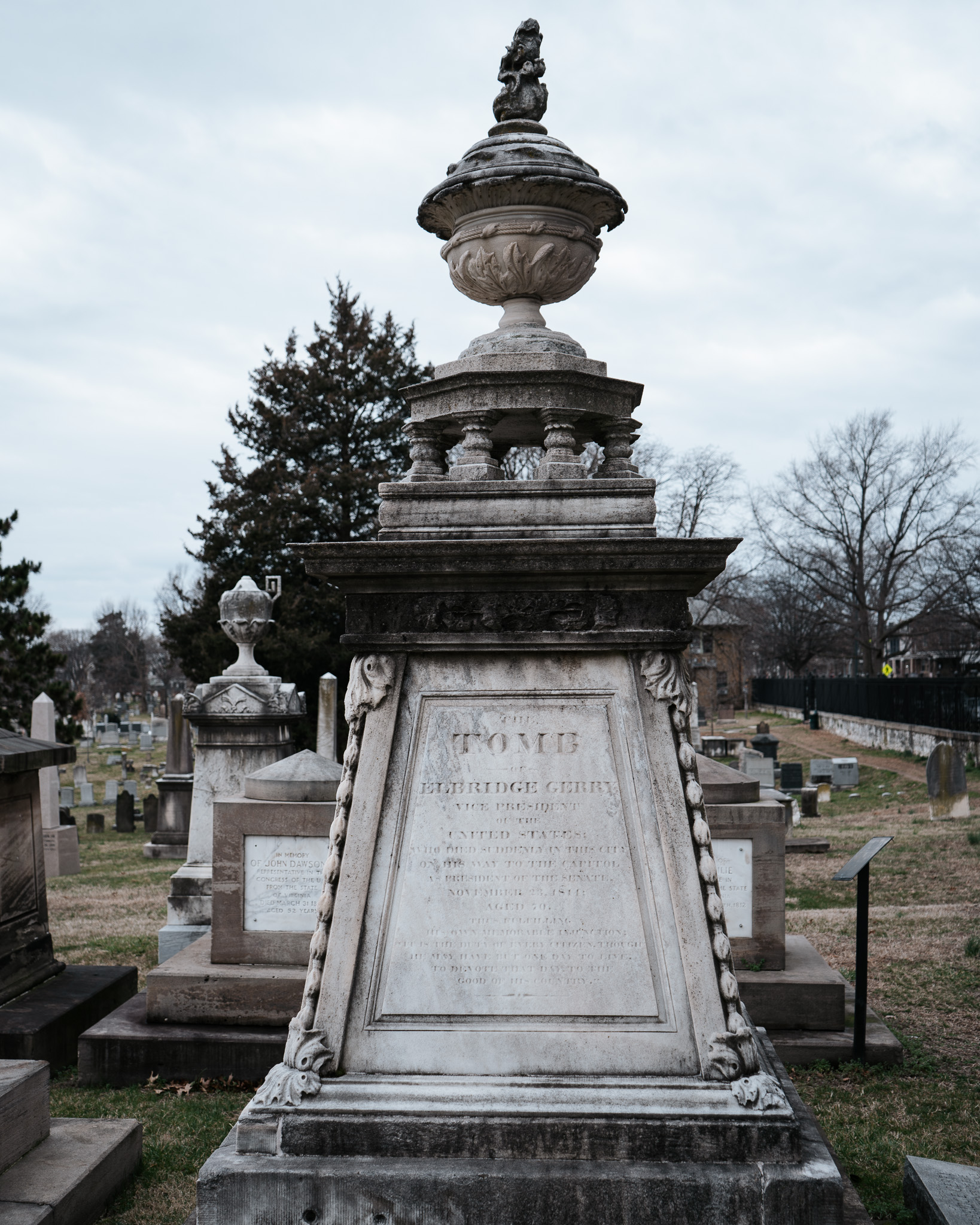
Elbridge Gerry’s 12-foot-tall grave monument was carved by brothers William and John Frazee of New York. Photo by Kitty Linton.
Man from Marblehead
Elbridge Gerry was born July 17, 1744 in the fishing and shipping port of Marblehead, Massachusetts. According to descendants, the family pronounces Gerry with a hard G sound (geh-ree), rather than the soft G that has predominated in public perception. Elbridge Gerry was just 14 when he matriculated into Harvard College. He graduated in 1762 and then pursued a master’s degree, which he earned in 1765. In his dissertation, he advocated for colonial resistance against the nascent Stamp Act. Commerce was an important part of Gerry’s upbringing. His father, Thomas, was a ship captain and a merchant and, for a time, Gerry worked in his business, which shipped cured fish to Barbados and Spain.
However, it was the tumultuous political scene that called to young Gerry. In 1772, still in his twenties, he was selected to represent Marblehead in the Great and General Court. There he first became acquainted with political radical Samuel Adams, with whom he closely worked and was often aligned. It was also in this period that he was elected to the Massachusetts legislature and was selected for Marblehead’s Committee of Correspondence. These committees were part of a system throughout the colonies that allowed for an exchange of ideas on how to resist and respond to ever-stricter imperial policies imposed by the British government. In 1774, Gerry was chosen to serve in the First Continental Congress, but he declined this post in the aftermath of his father’s death that July.
Philadelphia Freedom
By February 1776, ten months after the first official shots of the Revolutionary War were fired in Lexington, Massachusetts, Gerry was a member of the Second Continental Congress, replacing Thomas Cushing. Whereas some members of the body convened in Philadelphia were still hesitant to break ties with Britain, 31-year-old Gerry was immediate and steadfast in his calls for independence. This endeared him to delegate John Adams, Samuel’s cousin from Braintree, Massachusetts. In July, Adams wrote to friend James Warren that Gerry “is a Man of immense Worth. If every Man here was a Gerry, the Liberties of America would be safe against the Gates of Earth and Hell.”
Gerry was among the delegates who voted for independence from Great Britain on July 2, 1776, and for the Declaration of Independence on July 4. He departed Philadelphia soon thereafter, returning to Massachusetts in a bid to restore his ill health. On July 21, a traveling Gerry wrote Samuel and John Adams and asked them to sign the Declaration on his behalf “if the same is to be signed as proposed. I think We ought to have the privilege when necessarily absent of voting and signing by proxy.” Proxy signing was not approved, and most delegates to the Continental Congress signed the Declaration on August 2. Gerry affixed his signature after he returned to Philadelphia, likely in September. During the Revolutionary War, Gerry leveraged his merchant connections to help keep the Continental Army supplied with the indispensable gunpowder, without which the Army would have been unable to even take the field.
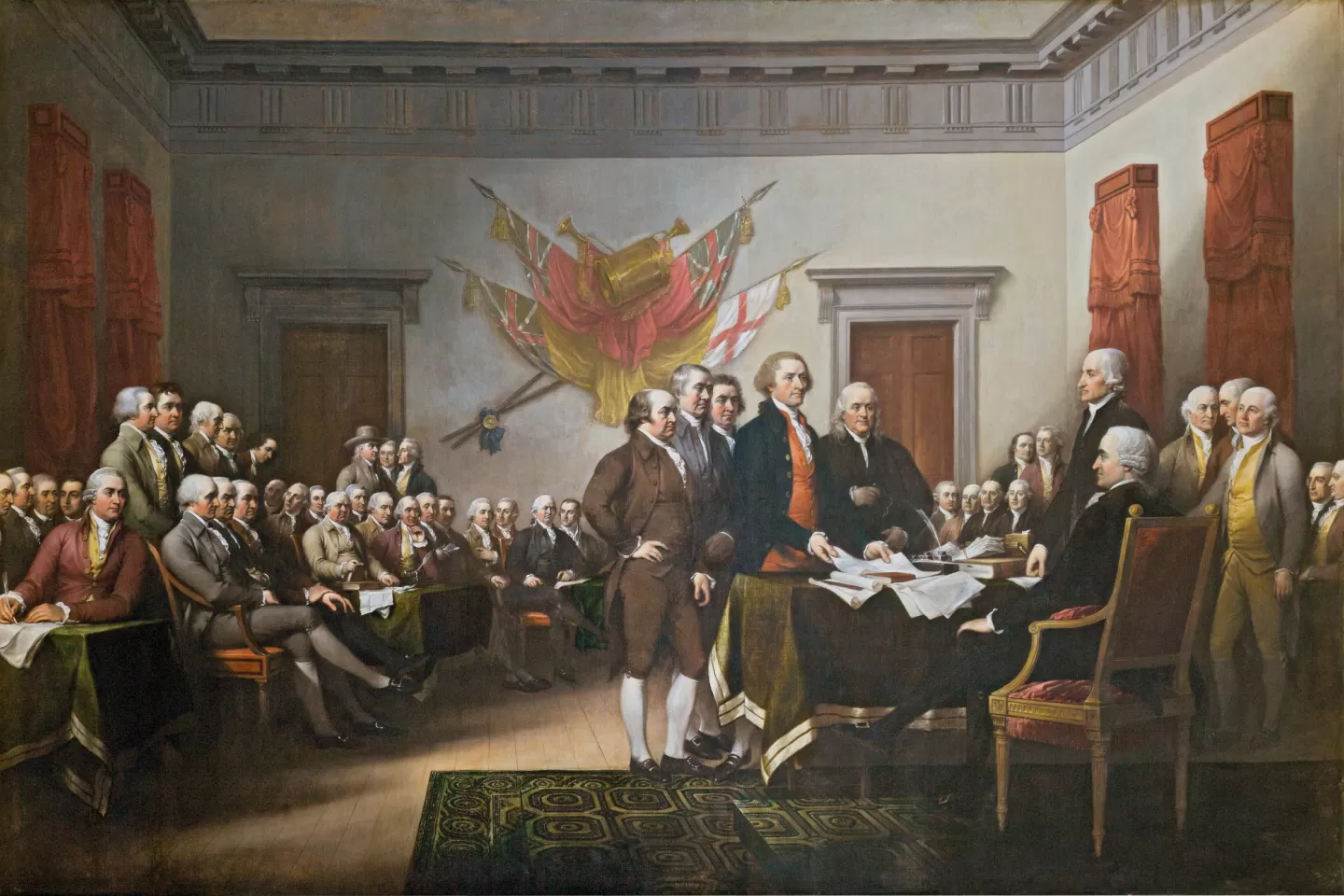
John Trumbull’s Declaration of Independence, which was commissioned in 1817 and hangs in the Capitol Rotunda. Elbridge Gerry is depicted at the second table from the left, wearing a burgundy coat and holding his hand to his chin. Architect of the Capitol.
A New Country
After the Revolution, in 1787, Gerry was once again sent to Philadelphia to meet with a body of men. This gathering evolved into a constitutional convention, with its end product replacing the ineffective Articles of Confederation that had governed the disparate states since 1781 (and which Gerry had signed). On May 31, Gerry gave a warning in response to the motion that members of the House of Representatives “ought to be elected by the people of the several States.” With the memories of Shays’s Rebellion on his mind, he declared, “The evils we experience flow from the excess of democracy. The people do not want virtue, but are the dupes of pretended patriots.” The National Constitution Center says “he managed to irritate almost every other delegate because of his unpredictable and often contradictory stances on the central issues facing the Convention.”
After eleven weeks, the weary delegate wrote to his wife, Ann Thompson Gerry, “I never was more sick of any thing than I am on conventioneering: had I known what would have happened, nothing would have introduced me to come here.”
In the end, in large part because the adopted Constitution lacked a Bill of Rights, Gerry, along with George Mason and Edmund Randolph, declined to sign the document. Nevertheless, Gerry quickly became an official in the new government that the Constitution provided. He was an inaugural member of Congress and served from 1789 to 1793.
Alphabetical Annoyance: The XYZ Affair
In 1797, amid tensions with the French Republic, President John Adams nominated Gerry to be an envoy extraordinary to France. Based on previous conversations, Adams knew his staunch Federalist cabinet would protest the nomination of the Republican-leaning Gerry. Even his dearest friend and advisor, First Lady Abigail Adams, had concerns about Gerry’s fitness for the role. But the president trusted Gerry and that won out. Even though Adams’s duplicitous Secretary of State, Timothy Pickering, made a gambit to block the nomination, the Senate approved Gerry for the post, 21-6. Along with John Marshall and Charles Cotesworth Pinckney, he was dispatched to France.
Despite Adams’s instructions to Gerry that he should maintain a unified front with his fellow envoys, Gerry faltered. Pinckney wrote to his brother that Gerry was “habitually suspicious, and hesitates so much, that it is very unpleasant to do business with him.” Sometimes Gerry hosted social gatherings that included French agents but excluded Marshall and Pinckney. They did show a united front on one crucial aspect: they would not give in to foreign minister Charles Maurice de Talleyrand’s demand of a bribe to put them in contact with French diplomats. When Adams released documents relating to the incident to Congress, the names of the three diplomats were replaced with the letters X, Y, and Z, leading to this being called the XYZ affair.
Even after Marshall and Pinckney left, Gerry remained in France. Though he said the French would not consent to his departure, his actions were largely unpopular in the US. When he returned home, his carriage was pelted with rocks and he was burned in effigy. When he met with the president in Massachusetts, Adams admonished him. Nevertheless, when Timothy Pickering assembled a report for Congress, Adams eliminated passages critical of Gerry’s actions before turning it over to Congress on January 21, 1799.
With negotiations unsuccessful, the U.S. and France engaged in an undeclared war, known as the Quasi-War, from July 1798 to September 1800.
Lamentable Legacy: The Namesake of Gerrymandering
More firmly positioned as a Republican after the Federalist response to his conduct in France, Gerry was several times an unsuccessful candidate for Massachusetts governor. In 1810, he was finally victorious. As governor, he was notably presented with a bill to reshape congressional district lines in dramatic ways. Although he supposedly found the legislation to be “highly disagreeable,” Gerry signed it into law. “Towns were separated and single towns were isolated from their proper counties,” Elmer C. Griffith explains in his 1907 dissertation, The Rise and Development of the Gerrymander. One district within Essex County surrounded Massachusetts’s North Shore and was so misshapen that an opposing Federalist said it resembled a salamander, an amphibian popular in mythology and pre-modern folklore.
Artist Elkanah Tisdale’s political cartoon of this “Gerry-mander” was published in the Boston Gazette on March 26, 1812. It was reprinted widely by the Federalist press. Although this was not the first instance in American politics where questionable motivations resulted in wonky district boundaries, the political cartoon resonated. Gerrymandering entered the political lexicon and never left.
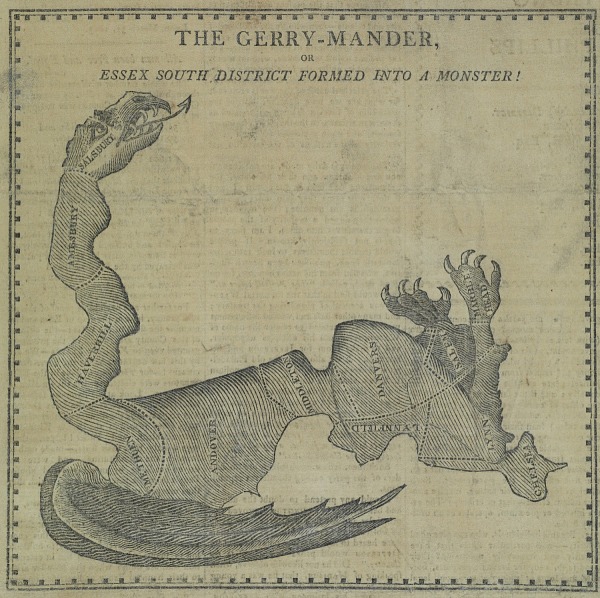
The “Gerry-mander” was first published in the Boston Gazette in March 1812. It was republished in many Federalist newspapers. This iteration was printed in the Salem [Massachusetts] Gazette on April 2, 1813. National Museum of American History.
From the Vice Presidency to Congressional Cemetery
In April 1812, Vice President George Clinton died in office, and he needed to be replaced on the Democratic-Republican ticket. Gerry, defeated in his gubernatorial re-election bid that same month, was later drafted as the running mate of the incumbent president, James Madison – the “father” of the Constitution Gerry had refused to sign at the 1787 convention. Madison and Gerry were victorious in November, beating the Federalist duo of DeWitt Clinton and Jared Ingersoll.
Like his predecessor, Gerry was unable to see his vice presidential term through to the end. On Wednesday, November 23, 1814, Senator Rufus King of New York wrote former President John Adams with the “melancholy information” that his friend of nearly 40 years was gone.
“The Vice President was dressed as usual to attend Senate this morning, went in his carriage to call upon Mr. [Joseph] Nourse of the Treasury Department, complained while there of feeling unwell, was helped by Mr. Nourse into the carriage to return to his Quarters, distant not more than a quarter of a mile, was senseless when he arrived there, and on being taken out, and laid upon a Bed, immediately expired without a Groan or a Struggle.”
On the heels of the passing of Robert Treat Paine in May 1814 and James Lovell in July, Gerry’s death suddenly left Adams with no surviving colleagues from his time in the Second Continental Congress. “I am left alone,” Adams lamented. In his reply to Senator King, he pitied his late friend’s treatment and worried about what would befall Gerry’s family. “Can there [be] any deeper damnation in this Universe, than to be condemned to a long Life? in danger Toil and Anxiety? to be rewarded only with Abuse Insult and Slander? and to die at Seventy, leaving to an amiable Wife and nine amiable Children nothing for an inheritance, but the contempt hatred and Malice of the World?”
Senator Christopher Gore of Massachusetts proposed a bill that would have granted the widowed Ann Gerry to continue to receive the remainder of her husband’s vice presidential salary. The bill failed to pass.
Gerry was interred at Congressional in Range 29, Site 10, near his predecessor, George Clinton. The government-funded monument was erected over his body in 1823. With Clinton’s exhumation in 1908, Gerry stands alone as the highest-ranking government official among the cemetery’s permanent residents. He is the lone vice president interred in Washington, D.C., as well as the only Declaration of Independence signer buried in the capital of the nation he helped found.
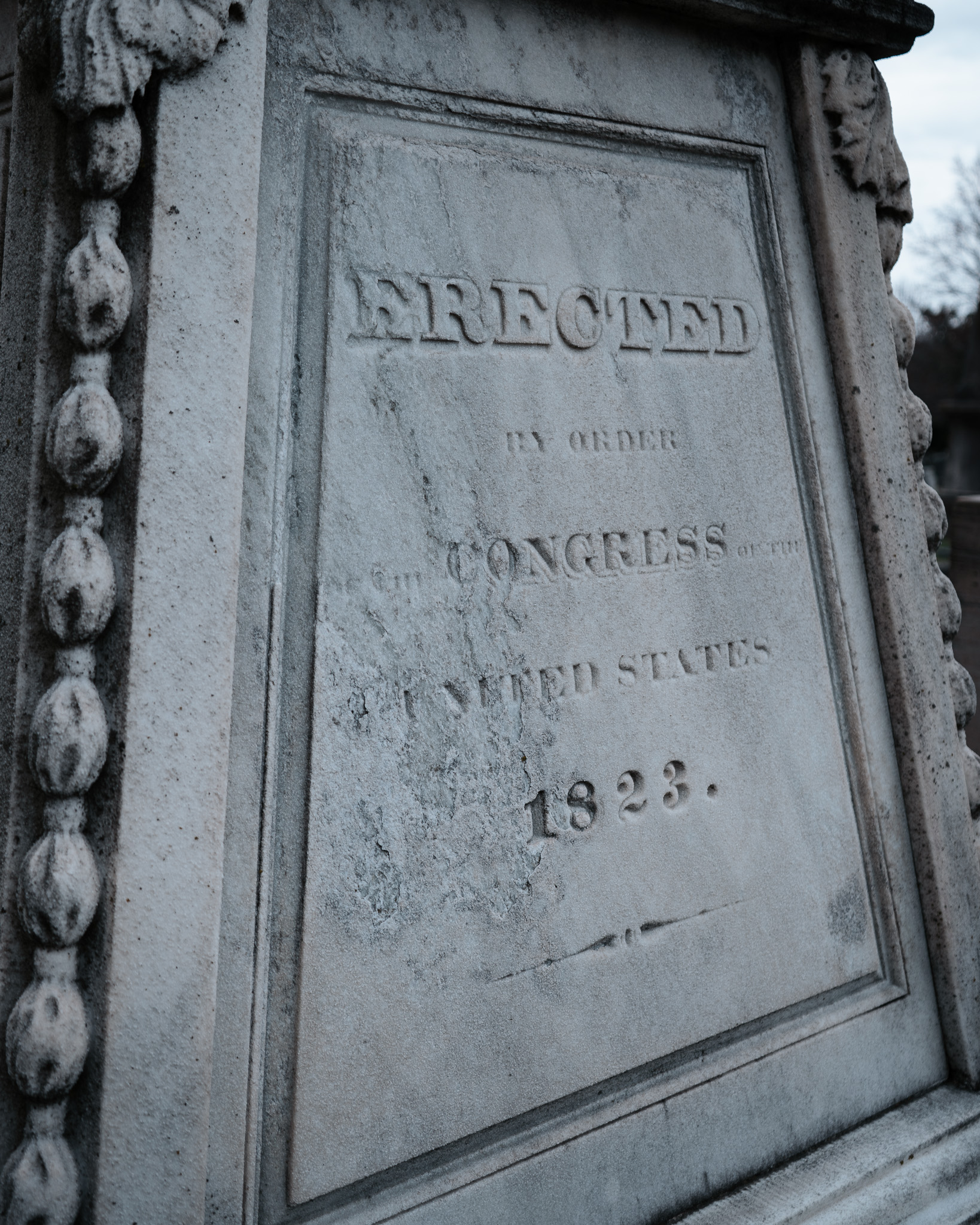
Gerry’s tomb was erected in 1823 by order of Congress. Photo by Kitty Linton.
Works Cited
Adams, John. John Adams to James Warren, July 15, 1776. Letter. From National Archives, Founders Online. Accessed March 19, 2026. https://founders.archives.gov/documents/Adams/06-04-02-0162.
Adams, John. John Adams to Rufus King, December 2, 1814. Letter. From National Archives, Founders Online. Accessed May 12, 2026. https://founders.archives.gov/documents/Adams/99-02-02-6358.
Chervinsky, Lindsay M. Making the Presidency: John Adams and the Precedents that Forged the Republic. Oxford: Oxford University Press, 2024.
Congress.gov. “Wednesday, June 23, 1790.” Journal of the House of Representatives of the United States, 1790. Accessed March 17, 2026. https://www.congress.gov/house-journal/247.
Epstein, Reid J. and Madeline Marshall. “Attention, America: We’ve All Been Saying Gerrymander Wrong.” Wall Street Journal. May 24, 2018.
Gerry, Elbridge. Elbridge Gerry to Samuel and John Adams, July 21-22, 1776. From National Archives, Founders Online. Accessed March 19, 2026. https://founders.archives.gov/documents/Adams/06-04-02-0174.
Griffith, Elmer C. The Rise and Development of the Gerrymander. Chicago: Scott, Foresman & Co., 1907.
King, Rufus. Rufus King to John Adams, November 23, 1814. From National Archives, Founders Online. Accessed May 12, 2026. https://founders.archives.gov/documents/Adams/99-02-02-6352.
Madison, James. “Madison Debates May 31.” May 31, 1787. Yale Law School, The Avalon Project. Accessed March 18, 2026. https://avalon.law.yale.edu/18th_century/debates_531.asp.
Morison, S.E. “Elbridge Gerry, Gentleman-Democrat.” New England Quarterly 2, no. 1 (1929): 6-33. Accessed March 16, 2026. https://www.jstor.org/stable/359818.
National Constitution Center. “Elbridge Gerry.” Accessed January 12, 2026. https://constitutioncenter.org/signers/elbridge-gerry.
National Park Service. “August 26, 1787: A Day of Rest.” Accessed May 13, 2026. https://www.nps.gov/articles/000/constitutionalconvention-august26.htm.
Verheyen, Egon. “William and John Frazee’s Gerry Monument in the Congressional Cemetery in Washington.” Records of the Columbia Historical Society, Washington, D.C. 52 (1989): 92–103. Accessed March 2, 2026. http://www.jstor.org/stable/40067861.


President's Pick
May 17, 2022
stay up to date
When you sign up for our mailing list, you’ll receive closure notifications, event information, and general updates.